Discovering the world's deepest gas hydrate seeps
The world's deepest known gas hydrate cold seeps and the marine life that thrives around them are now revealed in our paper from the Arctic Deep - Extreme24 expedition.
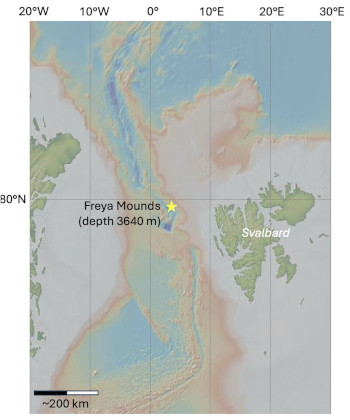
Aboard the icebreaker RV Kronprins Haakon with REV Ocean's Aurora ROV, we discovered the "Freya Mounds" - a cold seep ecosystem where blocks of methane hydrate poke out of the seafloor, at 3640 metres deep on the Molloy Ridge in the Fram Strait of the Arctic.
Methane hydrate is a bizarre form of "fire ice", where methane is trapped in a cage of water molecules. It forms a buried layer beneath the seabed in lots of parts of the world, and sometimes outcrops at the seafloor, but most of those outcrops are on continental slopes at less than 2 km deep.
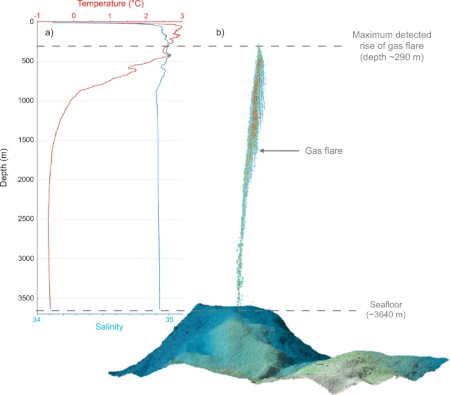
We traced a plume of methane bubbles rising ~3.3 km above the seafloor to find the "Freya Mounds", which are more than 1.7 km deeper than other cold seep ecosystems found in the Arctic so far.
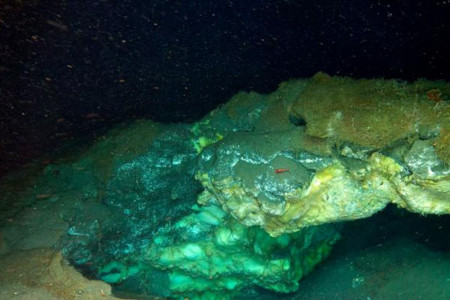
Across an area of a couple of football pitches, we found mounds of hydrate bulging out of the muddy seafloor. Some of the mounds have arches of exposed yellowish methane hydrate, fizzing away as it "melts" to release the methane bubbles (which fortunately don't quite reach the sea surface to release the gas into the atmosphere).
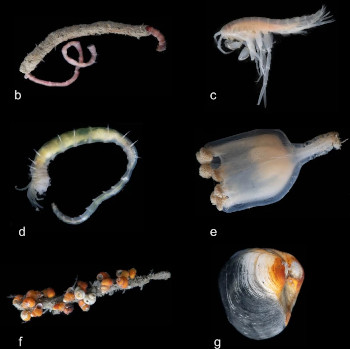
The methane nourishes bacteria, which in turn support a colony of deep-sea animals. The Freya Mounds are covered in lush "tubeworm forests", with shrimp, snails, and other animals crawling through them. There are also stalked jellyfish (unlike jellyfish that bob about in the ocean, these grow upside-down on stalks attached to the seabed). Further work by the international Ocean Census is underway to determine how many of the animals are previously undescribed species.
During the expedition we also explored some recently discovered hydrothermal vents (the Jotul Vent Field) at a similar depth (3020 m) nearby, where the marine life had not been surveyed before.
We found that the marine life at the gas hydrate seeps is related to what lives at hydrothermal vents at similar depth in the Arctic. That marine life is different to other areas of the deep ocean, because the Fram Strait of the Arctic is a rare place where deep-sea vents and seeps occur close to each other – and where vents and seeps are an important part of deep-sea biodiversity, because of past glacial conditions.
There are undoubtedly more deep methane hydrate ecosystems like this out there in the Arctic, as other deep bubble plumes have been detected nearby. So our discovery shows how much there still is to explore and understand about Arctic deep-sea life – and the need for caution and protection if Norway resumes plans for deep-sea mining there (put on hold earlier this month, but currently only pausing for 4 years).
There are lots of different types of "cold seeps" (which typically emit methane), driven by different geological or microbial processes. The Freya Mounds are the deepest methane hydrate (aka "gas hydrate") cold seeps, but they are not the "deepest known cold seeps" (or "deepest methane seeps") - those are at >9 km deep in the Aleutian and Kuril-Kamchatka Trenches of the Pacific, created by a different process.
Jon Copley, December 2025
| Previous | Index | Next (t/c!) |